How to Choose a School Bag or Backpack for a First Grader? A Complete Guide for Parents
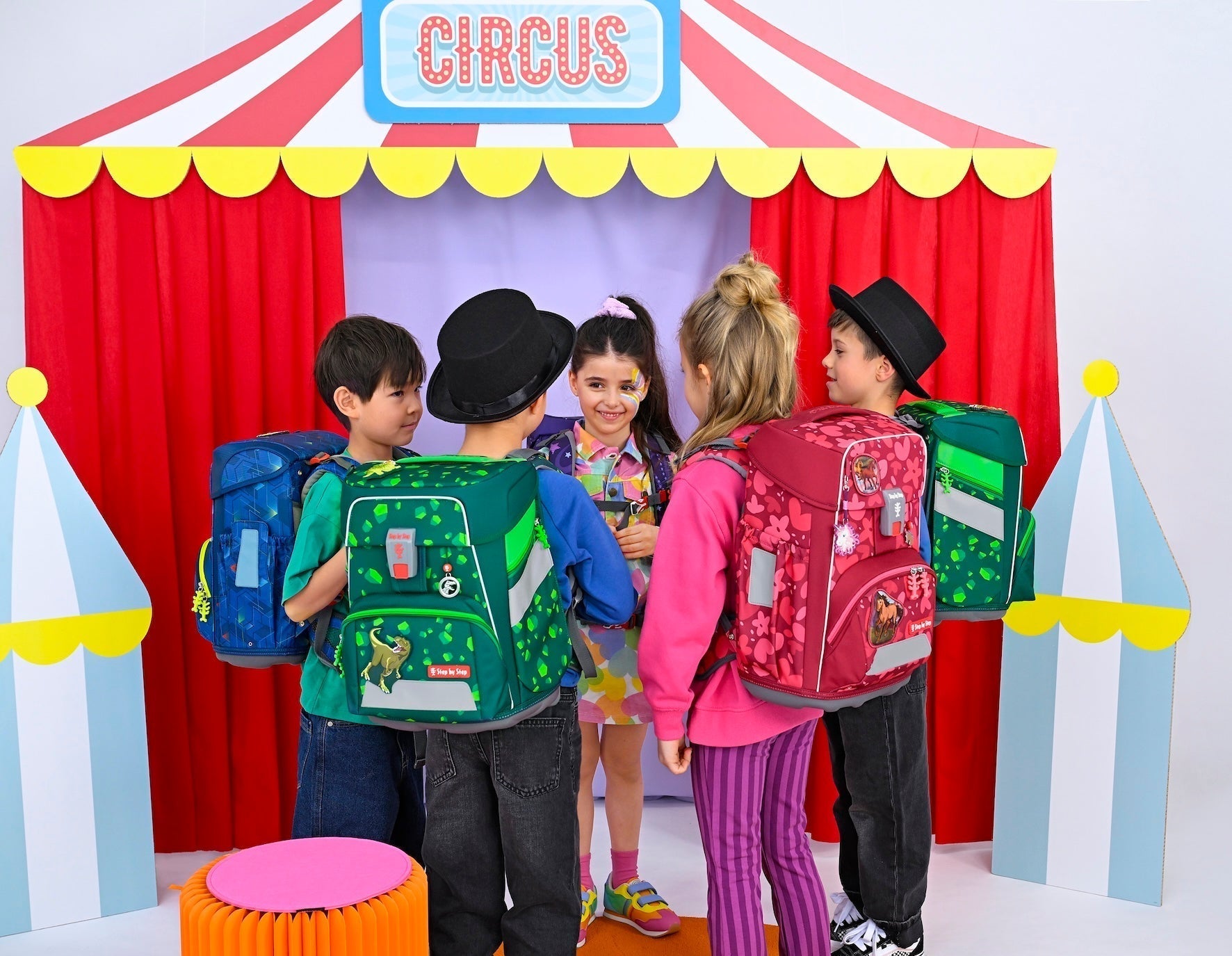
Starting first grade is a big milestone – and with it comes a question that thousands of parents deal with every year: how to choose a school bag for a first-grader that is comfortable, healthy, and liked by the child? This guide will provide the answers, whether you're considering a school bag, a backpack, or are still undecided.
School bag or backpack for a first-grader?
Parents often hesitate whether to choose a school bag or a backpack for a first-grader. Both Step by Step options have an AGR certificate, ergonomic back panels made of fiberglass, adjustable straps, chest and hip belts, and ORALITE reflective elements.
The main difference? A school bag has a firm structure with a flap. When opened, the child sees the entire contents at once. A backpack has a more flexible design, is lighter, and more spacious.
- School bag (CLOUD, FIT, SPACE, GIANT, BASIS series) – a firm, single-compartment structure with a Fidlock magnetic closure that the child can easily open with one hand. Main compartment with an internal pocket for heavier items, front pocket with thermal insulation, waterproof sturdy bottom. Volume 19–23 l depending on the series.
- Backpack (GRADE series) – a flexible backpack with a sporty design. Closure with two magnetic buckles (height-adjustable, increases volume). Stable bottom with feet, insulated front pocket, side pockets with drainage holes. If a bottle leaks, the liquid drains before damaging school supplies. Volume 22 l, carrying capacity 7 kg, weight only 950 g.
Tip: Check out our school bags for 1st grade and backpacks for 1st grade.

7 key criteria: How to choose a school bag for a first-grader
1. Ergonomically shaped back
A child's spine is still developing, so the back of the school bag is the most important thing to focus on when choosing. Look for anatomically shaped padding that follows the natural curvature of the spine and breathable material to prevent the child from sweating unnecessarily. The shoulder strap adjustment system is also important. The school bag should be customizable to your child's exact figure.
A reliable guide is the AGR certificate from the German organization Aktion Gesunder Rücken. This confirms that the school bag has passed independent ergonomic verification. All Step by Step school bags and backpacks offered by Step4Feet have this certificate.

2. Correct size according to body type
Buying a school bag "to grow into" is one of the most common mistakes. A bag that is too large fits poorly, slides down, and forces the child to lean forward. If you want to know how to choose the correct size school bag for a first-grader, follow a simple rule: the height of the school bag should correspond to the length of the child's back, from shoulders to sacrum.
How to tell if the school bag fits correctly:
- The top edge does not extend beyond the shoulders
- The bottom edge does not reach below the lumbar area
- The straps fit flush against the shoulders
The good news is that quality school bags today grow with the child. Step by Step uses the Easy Grow System, allowing the school bag to serve from 1st to 4th grade:
|
Child's height |
Recommended series |
School bag/backpack height |
|
from 100 cm |
CLOUD, FIT, SPACE, GRADE |
37–41 cm |
|
from 120 cm |
GIANT |
44 cm |

3. Weight
The total weight of a filled school bag should not exceed 10–15% of the child's body weight. If your first-grader weighs 20 kg, their school bag with contents should not be heavier than 2–3 kg. Therefore, it's important that the empty school bag itself is as light as possible.
In the Step by Step range, weights range from 950 g (GRADE backpack) to 990 g (CLOUD, FIT) and up to 1,250 g (SPACE) – all of them comfortably meet the standard.
Beware: School bags that are too light (under 800 g) may have a compromised back system. Low weight should never come at the expense of ergonomics.
4. Straps and belts
Straps are the contact point between the school bag and the child's shoulders. Poor straps mean pain and discomfort. What to look for:
- S-shape and soft padding – don't dig into the shoulders
- Adjustment straps – allow the school bag to be pulled snugly against the back
- Chest strap – keeps the straps in place so they don't slip off the shoulders
- Hip belt – transfers part of the weight from the shoulders to the hips, significantly easing the back
With Step by Step, both the chest strap and hip belt are removable and height-adjustable. The chest strap has a branded YKK buckle.
5. Reflective elements
The way to school often involves crossing roads or walking alongside them, and especially in winter, children leave in the dark. A quality school bag should have reflective surfaces on all sides. Front, sides, and shoulder straps, so the child is visible from all directions.
Step by Step school bags use ORALITE brand reflective material. From a manufacturer that also supplies reflective materials for traffic signs. For extra visibility, reflective stickers can be added.
6. Durable and eco-friendly material
A school bag spends a lot of time on the ground. In the changing room, in the classroom, on the pavement. It needs a sturdy, waterproof bottom and a water-repellent surface that can be easily wiped clean with a cloth. It's also worth checking what the school bag is made of. Eco-friendly materials today don't mean a compromise in quality, rather the opposite.
Step by Step school bags are made from 100% recycled PET bottles (37 bottles per school bag), the impregnation is PFC-free and water-based. They are also 100% vegan and bluesign® certified.
7. Practical internal organization
A first-grader is just learning to keep their bag tidy, so the school bag must help them, not complicate the situation. When choosing, check if it has:
- A main pocket with an inner pocket for heavier items – textbooks near the back ensure even weight distribution
- A front pocket for snacks – ideally with thermal insulation and drainage holes
- Side pockets for a water bottle
- Elastic bands in the flap for space-saving storage of a pencil case
5-piece sets are popular, where you get everything at once: school bag/backpack, a filled pencil case (Eberhard Faber branded pencils – 7 thick + 12 thin triangular colored pencils, rulers, eraser, sharpener), pencil pouch, sports bag with reflective elements (can be attached to the school bag), and interchangeable 3D Magic Mags images.

Which model series to choose?
|
Series |
Weight |
Volume |
Child's height |
What makes it different |
|
CLOUD |
990 g |
19 l |
100–150 cm |
Lightest school bag, rotary adjustment mechanism |
|
FIT |
990 g |
19 l |
100–150 cm |
Sports school bag, hidden AirTag compartment |
|
SPACE |
1,250 g |
20 l |
100–150 cm |
More robust, lockable side pockets, padded handle |
|
GIANT |
YOUR CART (0)Special instructions for sellerWhat are you looking for?
|